ARTIST PROFILE – KIRRILY HAMMOND
Gallerysmith is delighted to share the next edition of our ARTIST PROFILE SERIES, where we take you beyond the gallery walls to discover what really happens inside the creative worlds of our artists. Each profile invites you into their private studio spaces, where they share histories, personal stories, current projects and insights into the ideas, processes and experiences that shape their art practices. Along the way, we reveal works in progress and occasionally, a first glimpse of new works that have just become available. For collectors, this is your insider access, and an opportunity to discover, learn and engage with art practices on a deeper level.
In this edition, we venture all the way to the northern hemisphere and the Copenhagen studio of Kirrily Hammond, where the Australian artist has been living and working since 2018.
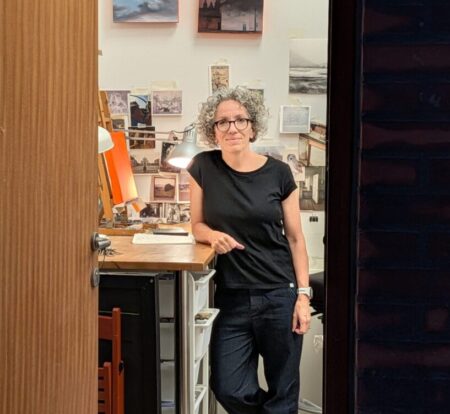
Kirrily Hammond has traversed a career in the visual arts for more than 30 years, from a curatorial and collection management position at Monash University Museum of Art to a scholarship at the British Museum, and more recently, by establishing an experimental art space in Copenhagen. Alongside these academic pursuits, Hammond has steadfastly maintained a dedicated studio practice, where, over three decades, she has established herself as a respected and coveted landscape painter, creating works that transcend the depiction of place to evoke atmosphere, memory and emotion. Since relocating with her family to Copenhagen in 2018, her practice has entered a new chapter, shaped by the subtle shifts in light, season and landscape of the northern hemisphere while remaining deeply connected to the Australian environments that first informed her vision. We recently caught up with Kirrily to talk about art and life in Denmark; the enduring pull of the landscape, and how living on the other side of the world has influenced her painting practice.
GS: Your paintings have long evoked what might be described as the sublime, that quiet sense of wonder where beauty, atmosphere and emotion converge. Do you think about the Romantic tradition of the sublime when you paint? Are there artists from history you have looked to?
KH: My inspiration for making images comes directly from my experience of a place, most often by the quality of light and how that can draw attention to small details in the landscape. It could be at sunset when golden light reflects on a windowpane, or when the light is fading in the countryside and details become ambiguous. The challenge is to capture those small, quiet moments of beauty and to create an image that allows space for the imagination.
I can see similarities between my practice and the Romantic tradition, in that both prioritise feelings and imagination; however, my interest is not in grand gestures of a figure overwhelmed by a majestic landscape, but rather in calling attention to moments of beauty that occur in our everyday suburban and rural landscapes, at a more intimate and relatable scale.
Artists that inspire me include Vilhelm Hammershøi, Clarice Beckett, Luc Tymans, Gunnar Norrman, Michaël Borremans, Odilon Redon, Pierre Huyghe and Mamma Andersson.
GS: There are many artists who paint the landscape, yet relatively few who convey emotional resonance at such an intimate scale. What do you think gives landscape the capacity to communicate feeling?
KH: It’s important to me that my landscapes are not immediately recognisable as specific places, because I want the focus of the work to be the emotional register of the image. I strive to evoke in the viewer the same feelings that inspired me to create the image in the first place. It could be a moment of quiet contemplation, communicated through a dark row of trees along a suburban street, or happiness, captured in the light reflected on the clouds. Often my paintings are an intimate size so that the viewer can relate to them on a one-to-one, human scale, thereby creating a personal connection.
GS: Many of your paintings explore the fleeting light of the gloaming; that brief moment between dusk and night, when forms begin to dissolve into blackness. What is it about this moment in time that draws you back?
KH: I find that time of day inspiring: the dissolution of details in the soft evening light allows the imagination to take over. It provides space in an image for something beyond pure representation, which is more of an emotive response to the landscape.

GS: You and Hamish made the significant decision to relocate with your family from Australia to Copenhagen in 2018. How does the quality of light in Copenhagen compare with Australia, and has living there changed your palette or the way you approach painting?
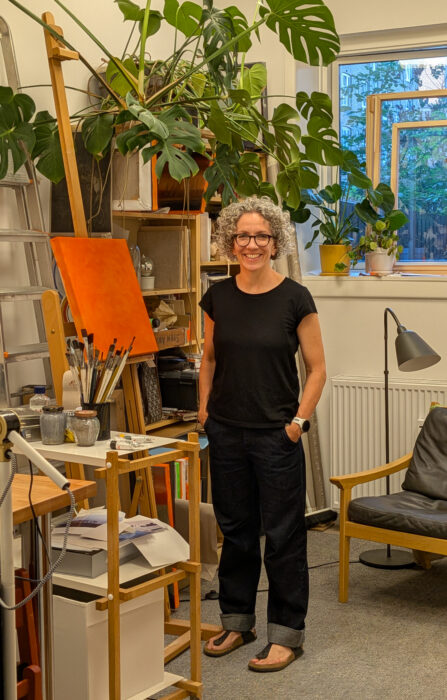
KH: One of the things that excited me when we moved to Denmark was the prospect of being able to capture a different quality of light in my paintings. I wanted to explore a more subdued palette to reflect the surrounding Scandinavian landscapes, especially during the winter. I enjoy the challenge of painting with more subtle colour shifts, which is a little different from the Australian landscapes.
There is a heightened awareness of the seasons in this part of the world, perhaps because of the stark differences in light between summer and winter. Mid-summer days begin at three in the morning and continue until ten or eleven at night, and it never really gets totally dark. Whereas in mid-winter, the sun doesn’t rise until eight and sets again at three in the afternoon.
GS: Over the years, your work has explored a range of urban and rural environments in Australia and now in the northern hemisphere. I’m wondering if there are certain types of places, for example coastal landscapes, forests or urban streets that you return to time and again for inspiration?
KH: The sky is a constant source of inspiration, and I enjoy the fact that my images of clouds or forest skylines do not necessarily depict recognisable places, as I hope others might connect to the works through an appreciation of the quality of light in the landscape and identify with the feeling captured in the work.
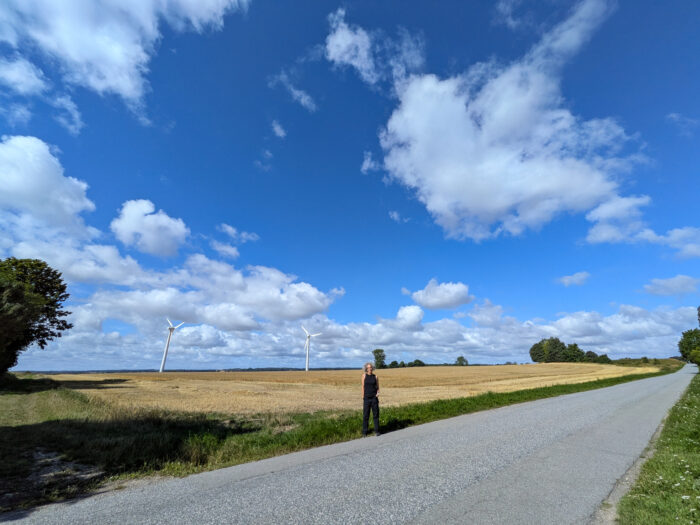
That said, I am always on the hunt for subject matter, and I have a large collection of source images that I’ve taken when I’m out and about. This includes Australian landscapes when I’m home visiting friends and family.
GS: Your paintings possess an extraordinary sense of calm, yet there are countless subtle and sometimes complex decisions made during the painting process. Can you describe how a painting develops in the studio, and how you know when it has reached completion?
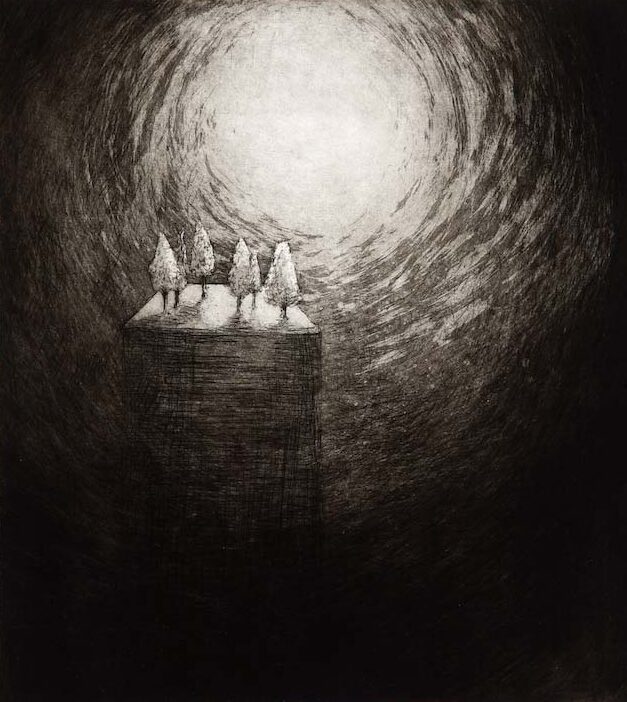
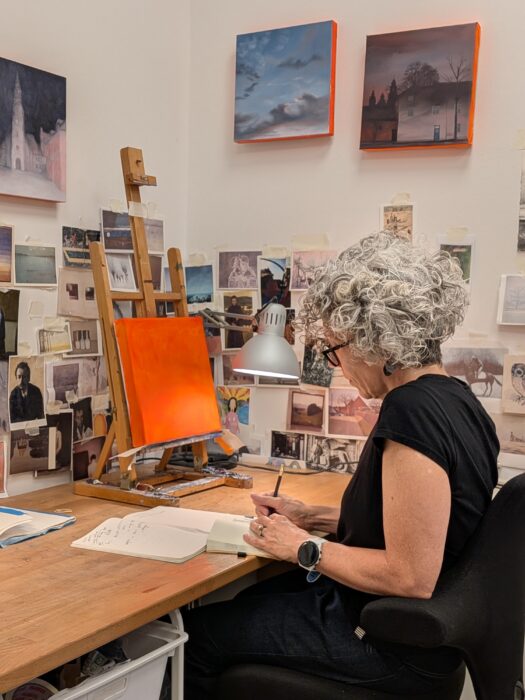
KH: My approach has remained the same for many years, in that I begin with a base layer of bright orange in all my paintings, and this provides a warmth that can be glimpsed through the subsequent layers of oil paint. This can be orange paint on linen, or the glow of copper, which I sometimes also use as a painting support. When I then start creating an image, I’m usually looking at my source images, often focusing on a small detail from a photograph. I then develop the painting intuitively, building the composition based on how the colours and forms interact, and deciding what is needed to capture a certain mood or feeling. Often there are multiple layers in each painting, especially if there are fine details such as powerlines or tree branches, and these works can take weeks or months to complete, as each layer needs to dry before the next is applied. For this reason, I usually have multiple paintings underway at any one time. I know when a work is finished when all the elements of the composition seem to come together and nothing jumps out to interrupt the cohesion of the image. It’s nice to know that my paintings appear calm – or perhaps contemplative, as that’s the head-space I need to be in, in order to paint them in the first place.
GS: And finally, what is next for Kirrily Hammond?
KH: Living in Copenhagen is a good balance of working part-time in a print studio called Borch Editions, and hosting exhibitions in my little gallery, Polygon Artspace, but my main focus is working in my studio. For me, one of the privileges of being an artist is the knowledge that there’s always something to go on with, there’s always the next thing to make. Each work can be a real struggle or flow easily, but there’s always something that comes out of it – something I’ve learnt or been inspired by, which naturally leads to the challenge of the next piece.
GS: Thanks Kirrily. We are excited to have some new works arriving from Copenhagen very soon!